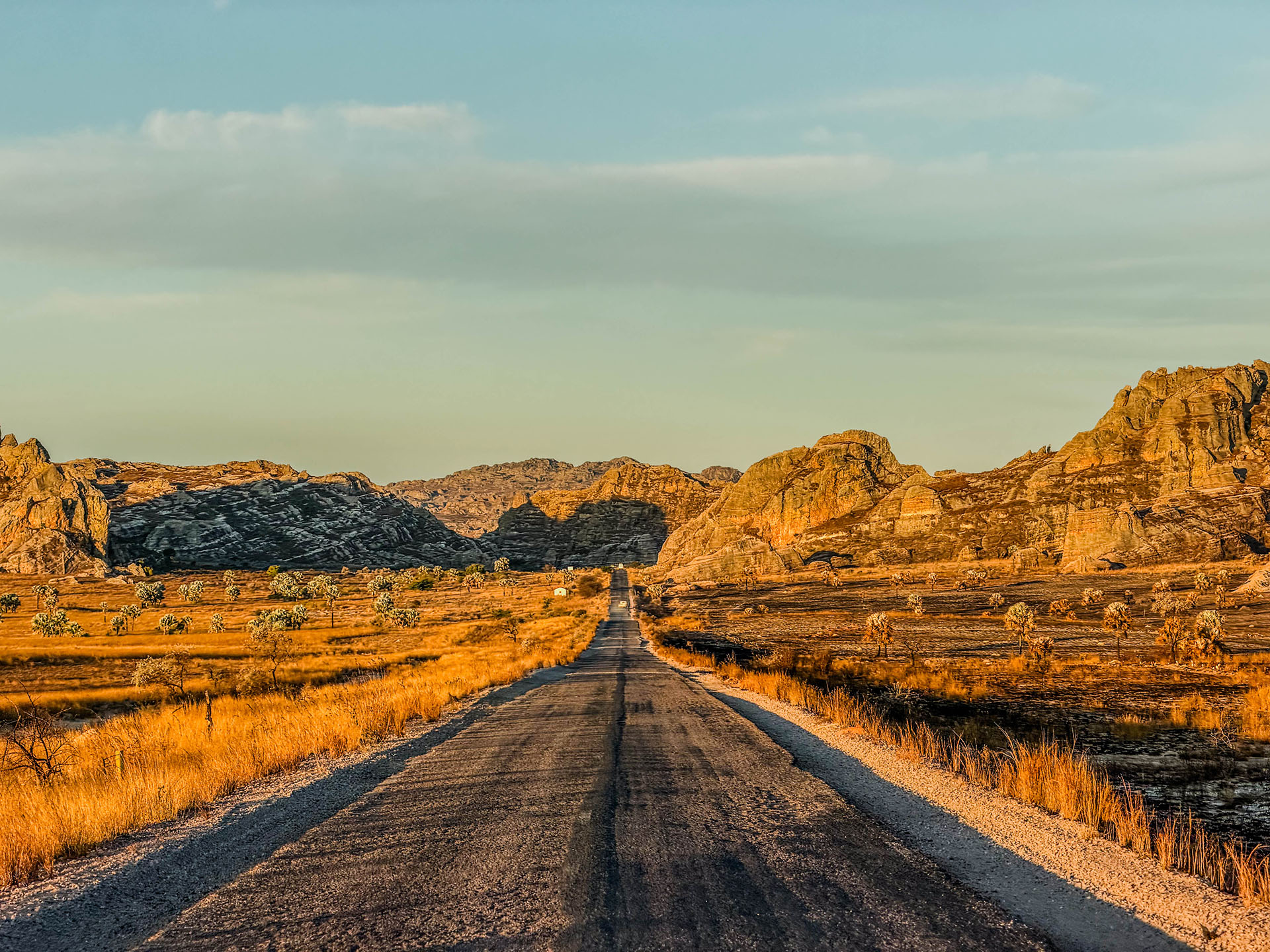
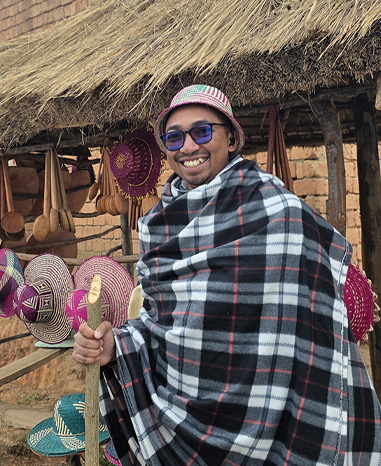
There is a moment on the RN7, somewhere after Ihosy, when the grass turns gold and the first walls of sandstone appear out of nowhere. The people in my car, who have been half asleep for an hour, sit up and reach for their phones. I stop the car every time. Nobody has ever complained about a stop for that view.
The road from Antananarivo to Isalo is long, and I won't pretend otherwise. But for a lot of my travellers it is also the best part of the trip. You leave the cool highlands and their rice fields, cross open plains, and end up at a massif that looks like it belongs on another planet. You see all of it from the window, at a speed that lets you notice things. Here is how I do it, and how I would do it if you were sitting in my back seat.
The RN7 in numbers
From Antananarivo to Ranohira, the small town at the gate of Isalo, it is about 700 km. On paper that is 18 to 20 hours of driving. In real life the RN7 is not a road where you set the speed and forget about it. There are climbs, bends, heavy trucks, zebu carts, and villages where the real speed limit is whoever happens to be crossing the road. So we never do it in one go.
My advice is to give it two days at the very least, and three if you can. Two long days work when you are short on time. Three days let you sleep in Antsirabe or Ambositra, walk around Fianarantsoa, and reach Isalo with enough energy left for the park. If you have four, add the Anja reserve and take your time.
The dry months, roughly April to October, are the easiest: clear skies, good light, cold mornings in the highlands. The rainy season, from January to March, is greener and quieter. The road is usually still fine, but expect slower driving and a few damaged sections.
Day by day, where I stop
You don't need every stop on this list. These are the ones I come back to most often, in the order we meet them.
Antsirabe, a good first night
Antsirabe is about 170 km from Antananarivo, three to four hours with traffic and a coffee break. It makes a good first night, especially if you left late. The pousse-pousse (rickshaws) are everywhere, and a short ride is more fun than it sounds, particularly if the driver is in a talkative mood. If you have time, the crater lake of Tritriva is a short drive out of town.
Ambositra, for the woodcarving
Another 100 km and you reach Ambositra, home of the Zafimaniry woodcarvers. The shops along the main street sell carved boxes, chess sets and window shutters. If you plan to buy one souvenir on the whole trip, buy it here. The money stays with the families who make the pieces.
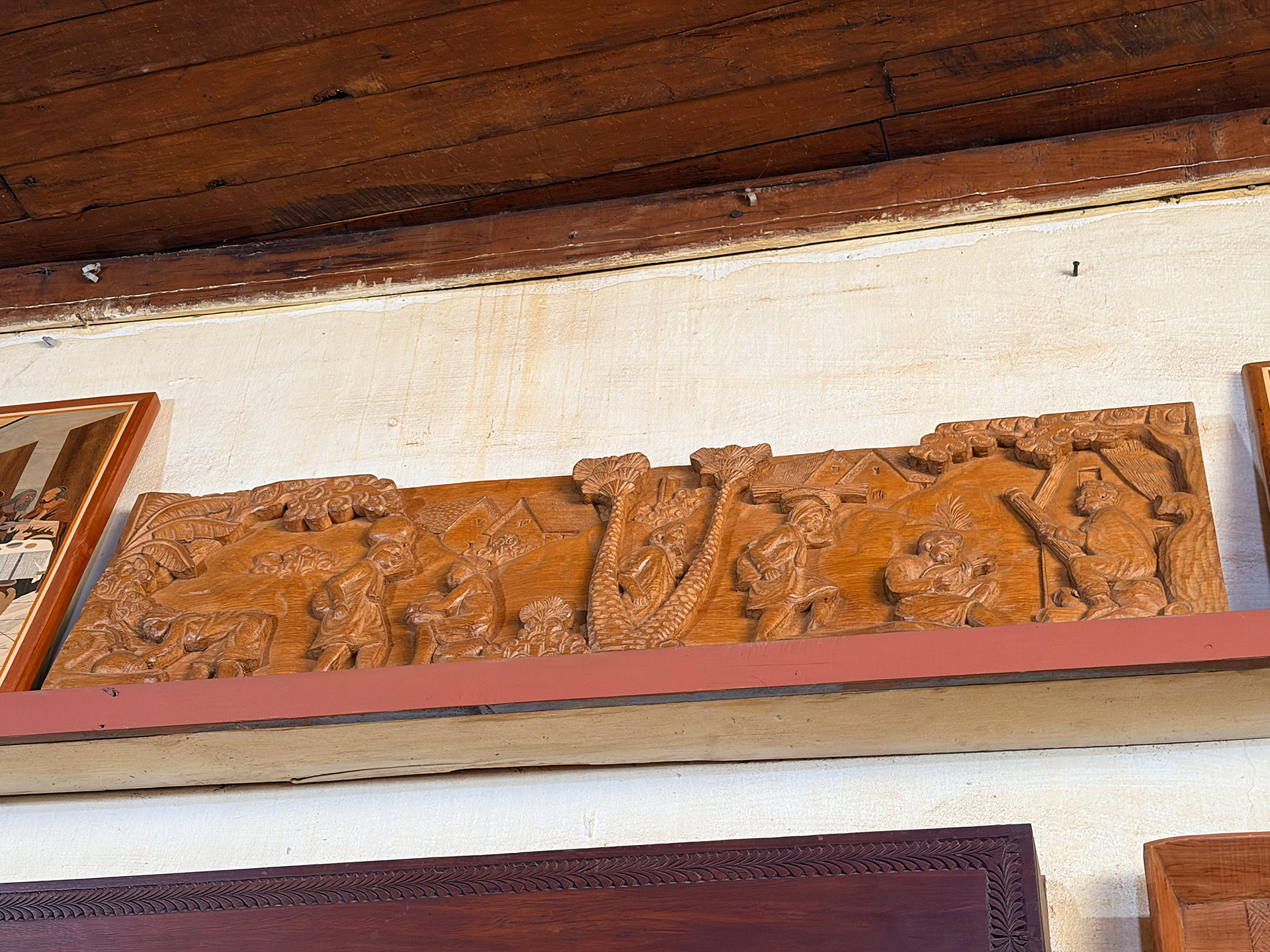
This carved panel, with its little scenes of village life, is the kind of piece you will find in the workshops. Take your time, ask who made it, and expect the price to depend on the size and the wood.
Fianarantsoa, the old town on the hill
Fianarantsoa comes about 130 km later. The upper town, the Haute-Ville, is all cobbled lanes, stone churches and wooden balconies, and it is best explored on foot. The Betsileo region around it grows tea and even makes wine, which surprises most people. I usually give it two hours.
Ambalavao and Anja
Ambalavao is about an hour further. It is known for Antemoro paper, handmade with pressed flower petals, and for its big zebu market. Just outside town, the Anja community reserve is the easiest place I know to see ring-tailed lemurs. The walk is short, the guides come from the village next door, and the lemurs don't seem bothered by anything.
Ihosy and the long plains
Ihosy is the last real town before Isalo, so it is where we fill the tank and have lunch. From here it is about 90 km to Ranohira. The road gets quieter, the villages get smaller, and the landscape begins to change.
Where the landscape changes
What I love about this road is that it changes country without telling you. Around Antsirabe it is terraced rice fields and red brick houses. After Ambositra the hills get steeper and patches of forest show up. Beyond Ambalavao the trees thin out, and past Ihosy you are on the Horombe plateau: open grassland, termite mounds, almost no trees, and a sky that feels twice as big. This is zebu country, where Bara herders have moved their cattle for generations.Then, slowly, the rocks begin. The best time to arrive is late afternoon, when the light turns the sandstone orange and the road itself seems to glow. That is the picture at the top of this page, taken on the road in to Isalo, with the car parked on the shoulder and nobody in a hurry.
Arriving in Isalo
Isalo is a sandstone massif cut by deep canyons, with green oases and palm trees at the bottom of them. Ranohira, the village at its edge, has lodges for every budget. Inside the park you walk with a park guide, and I would plan one full day, two if you can. The natural pool, the Namaza waterfalls and the Window of Isalo at sunset are the places people remember.
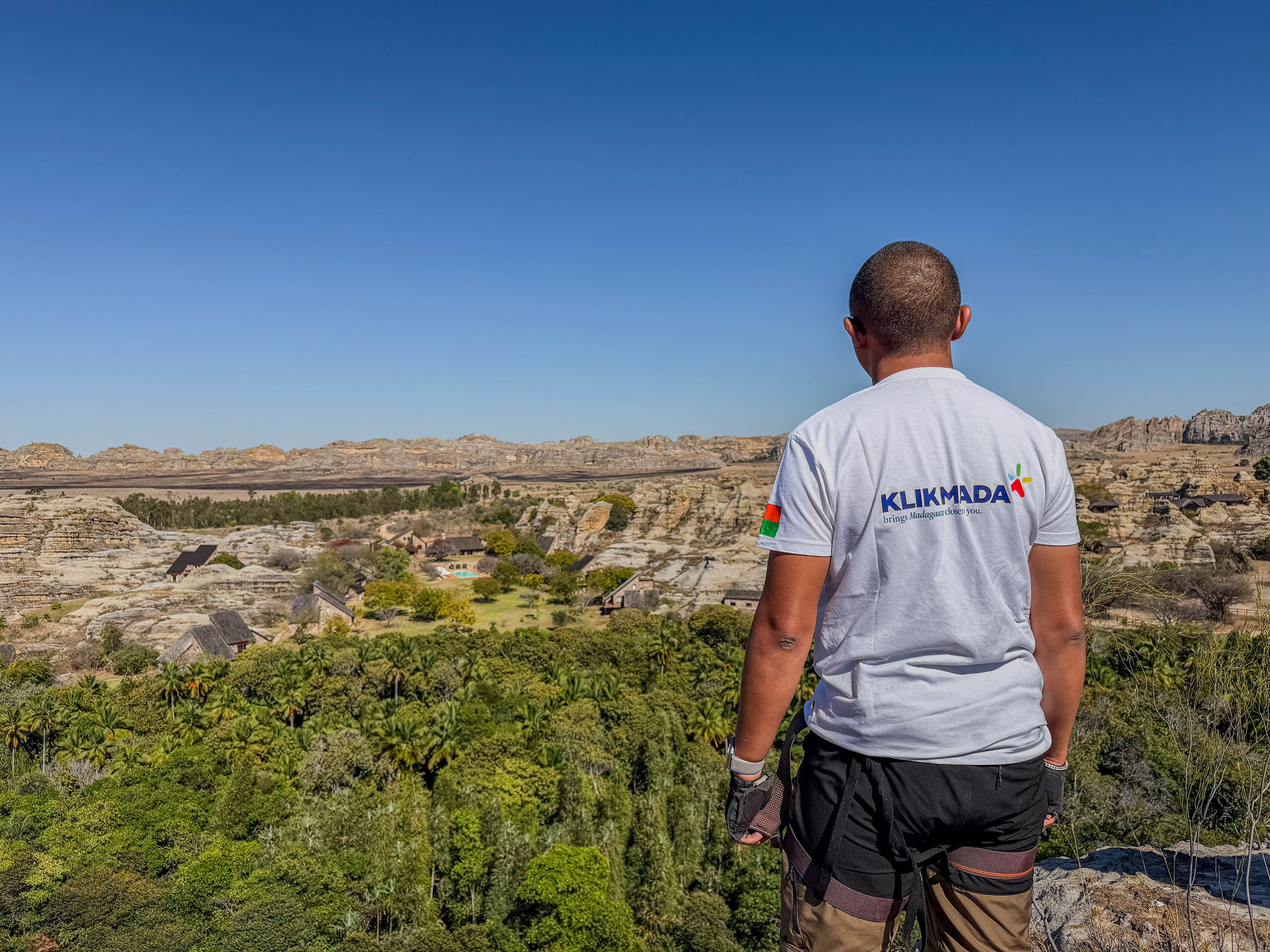
This is the view I like to show on the first morning, from a rocky viewpoint above the valley. You can see the lodges and the green palms down below, and the sandstone going on and on behind them. It helps people understand how big the place is before they start walking.
What I tell every traveller

Quick answers
How long is the drive from Antananarivo to Isalo?
About 700 km, which means 18 to 20 hours behind the wheel without counting stops. Plan at least two days.
Can I do it in one day?
Not realistically. With 18 to 20 hours of driving before a single stop, you would be on the road from dawn to well after dark, and the RN7 is not a road to drive at night. You would also miss everything it has to show you.
When is the best time to go?
April to October for dry weather and clear skies. If you care about photos, aim to be in Isalo at the end of the day.
If you would like to drive this road with me, tell me your dates and how much time you have, and I will build the days around you. Have a look at my guiding services, or read about a walk in the forest and a day in Antananarivo if you are planning the start of your trip.